Viking Oven Repair
Viking Oven Temperature Knob: Drift, Calibration and Replacement
A Viking oven temperature knob only tells the thermostat or control what heat you want, so if the oven bakes off the dial, check it with an oven thermometer at 350°F before buying a new knob. A slipping knob is an easy swap; real drift means the thermostat, sensor or igniter.
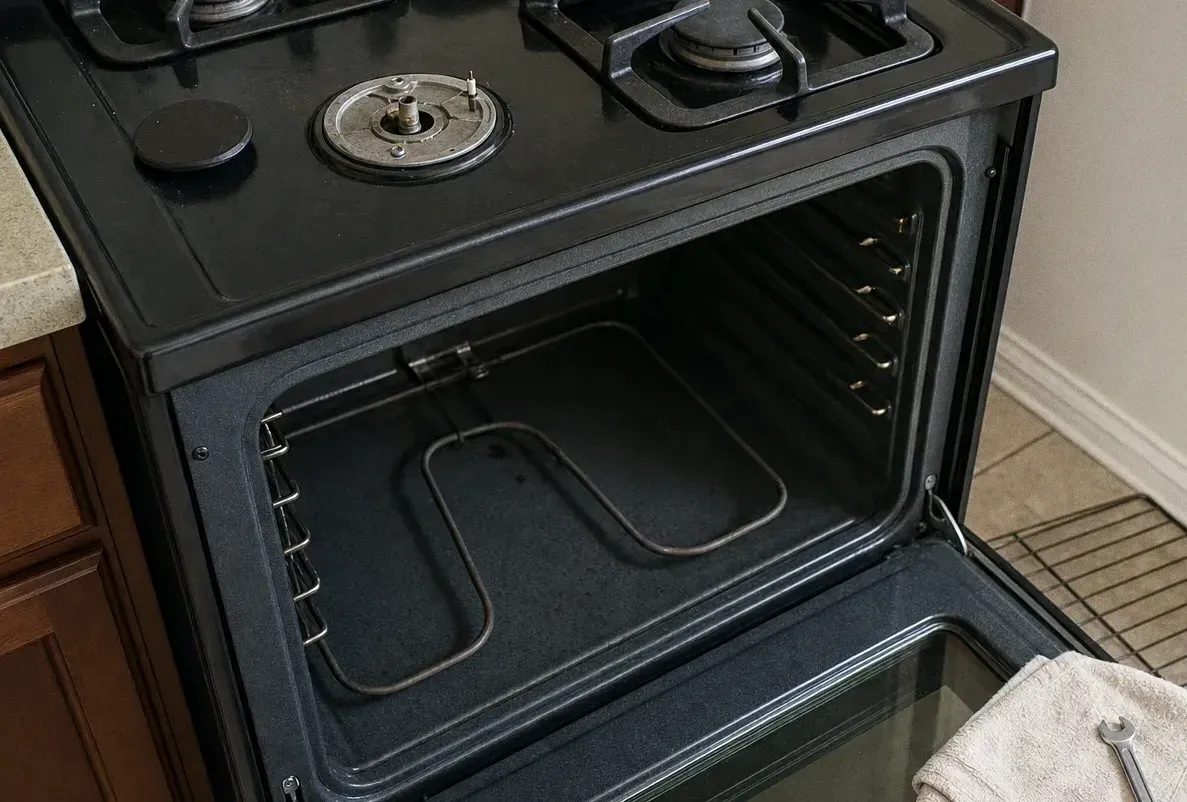
The temperature knob on a Viking oven is only the messenger. Turning it sets a thermostat on a gas range oven, or tells the electronic control on an electric wall oven what you want; the cap in your hand never makes heat itself. So when cookies brown too fast or a roast lags behind the recipe, put a standalone oven thermometer on the middle rack, turn the dial to 350°F, and read it about 20 minutes after the preheat signal. If the average sits near 350, the knob and the oven agree. If it is consistently 25 degrees or more away, you are dealing with calibration or a tired part, not the knob.
What the dial is connected to
On a 5 Series gas range, the oven knob governs a single 30,000 BTU bake burner, shaped like a U, plus the Gourmet-Glo infrared broiler at the top of the cavity. Both light through Viking’s SureSpark ignition, and there are six rack positions, which matters when testing because readings change with height. A gas oven holds its setting by switching the burner off and on, so short swings above and below the dial are normal.
Electric 5 and 7 Series wall ovens can be set anywhere from 200°F to 550°F, and their SET knob also turns to SAb, the Sabbath setting. If the display shows SAb and the oven seems to ignore you, someone may have switched on Sabbath mode; the manual has you leave it with the second control button. These ovens use the Vari-Speed Dual Flow convection system and suit multi-rack baking, so a convection fan that has slowed down can masquerade as a temperature fault.
Touch-control models such as the VESO5302T and VEDO5302T swap the dial for a keypad, yet they still judge cavity heat through a temperature sensor known as an RTD.
Testing the oven before you blame the knob
- Use a separate oven thermometer, never the oven’s own display, and stand it in the center of the middle rack, clear of the walls.
- Turn the knob to 350°F, wait for the preheat signal, then give it another 20 minutes.
- Take three readings about ten minutes apart, opening the door only for a moment, and average them.
- Repeat at 425°F. An oven that is right at one setting and wrong at another usually has a thermostat or sensor problem rather than a simple offset.
Skip testing straight after a self-clean. Viking’s self-cleaning ovens climb as high as 750°F to reduce soil to ash, and that extreme heat is when a weak sensor or thermostat tends to quit, so if the drift began right after a cleaning cycle, mention it when you call.
When the knob itself is the fault
A knob can cause the problem in one real way: it slips. The cap fits over a flat-sided shaft, and if the insert inside has split or worn round, the pointer can show 350 while the shaft underneath sits somewhere else. Hold the knob and rock it gently; if it wobbles or turns freely before the shaft engages, replace it.
To remove one, make sure the oven is off and cool, then pull straight toward you. A soft cloth looped behind the knob gives grip without scratching the panel. When ordering, quote the model and serial from the oven’s rating plate; a photo is not enough, since shafts, markings and pointers differ between ranges and wall ovens.
Gold, brass and red knobs are cosmetic choices and behave exactly like the standard ones. What counts is that the printed temperatures line up with the shaft, so 350 on the dial means 350 at the thermostat. The burner knobs on the rangetop feed separate burner valves, so keep them apart from the oven selector when ordering.
If the shaft feels gritty or stiff, or spins past its stops, the cap is fine and the thermostat or valve behind it is worn. That is a repair, not a knob swap.
Calibration: fixing a steady offset
When the oven is off by the same amount at every setting, calibration is often all it needs. Some older mechanical thermostats have an adjustment screw reached through the hollow shaft, and many electronic controls accept an offset from the keypad. The method varies by model, so follow your use and care manual, adjust in small steps, and retest with the thermometer.
Calibration is the wrong answer for an oven that wanders, say 20 degrees cold one evening and 40 hot the next. Chasing that with an offset only hides a part on its way out.
Sensors, thermostats and igniters
On electric ovens the temperature sensor is the usual suspect. A drifting sensor reads wrong without any warning, while a failed one often announces itself: on the VESO5302T and VEDO5302T, a long beep with RTD ERROR means the sensor circuit is open or shorted. Designer Series touch-control ovens can also show KEYBOARD ERROR when the keypad has lost contact with the control. Neither message clears for good with a reset, and for its RVL wall ovens, the MVSOE6301 and MVDOE6301, Viking suggests photographing any alert so the technician knows what the oven reported. A bake element with a blister or break heats slowly and unevenly, and a worn thermostat can switch late.
On gas ovens, weak ignition is a common reason an oven runs cold. If the burner takes a long time to catch, lights and then drops out, or you smell gas before it lights, each heating cycle starts late. Our guide to Viking spark, gas and moisture faults walks through those symptoms. If a gas smell lingers, turn the oven off and leave it off until it has been checked.
As typical ranges, an oven thermostat or heating element runs $240–$800, an igniter or burner assembly $280–$630, and a control board or touch panel $380–$940. You get the firm figure once the oven has been diagnosed.
Getting a Viking oven checked in Lexington
Viking Repair Lexington works on Viking ranges and wall ovens in Lexington Center, East Lexington, Countryside and Peacock Farm. Our visit is a flat $95 that pays for the trip and the whole diagnosis, and it is deducted from the repair if you proceed. Have your thermometer readings and any display message ready when you call (617) 300-0906. More detail is on our Viking oven repair page.
Still asked
Can I replace a Viking oven temperature knob myself?
Yes, usually in a minute or two. Once the oven has cooled, grip the worn knob behind its rim, draw it toward you, then push the new one home with its flat side matching the shaft. Quote the model and serial from the oven's rating plate when ordering, so the markings match. If the shaft itself is stiff or loose, the thermostat or valve needs attention instead.
Do gold, red or brass Viking knobs change how the oven works?
No, the finish is purely cosmetic. A coloured or metal-look knob sits on the same shaft and passes the same setting as a standard one. What matters is that it is the correct part for your model, so the printed temperatures line up with the thermostat underneath.
How far off can a Viking oven be before it needs repair?
An average within about 25 degrees of the dial is usually fine, because gas and electric ovens both cycle above and below the setting. A larger offset that stays the same can often be calibrated. Readings that change from day to day, or a display message such as RTD ERROR, point to a failing part rather than an adjustment.
Why does my Viking oven knob turn but the oven never gets hot?
The fault is usually behind the knob, not in it. On a gas oven, weak SureSpark ignition or a burner that will not stay lit is the common cause; on an electric oven, look to a failed bake element, sensor or control. First confirm the knob is not slipping on its shaft, then book a diagnosis.
What does the $95 visit include?
It pays for the trip and a full diagnosis of why the oven runs hot, cold or not at all. If you decide to go ahead with the repair, that $95 comes off the bill, and you hear the firm price before any work begins.